Automated Investor–Startup Matching Eliminating Manual Sourcing Chaos
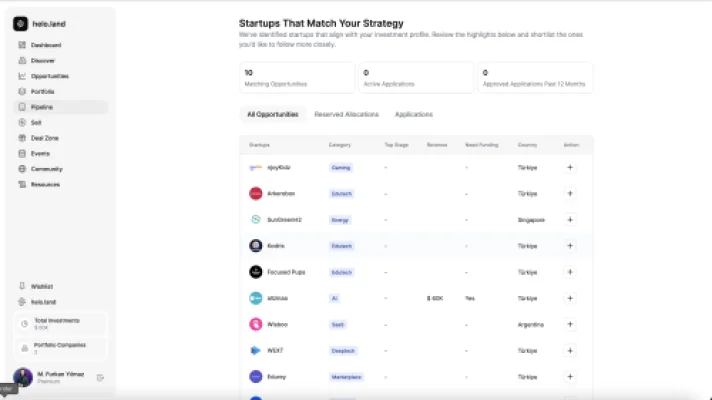
For helo.land, we led the end-to-end delivery of an investor–startup matching engine built on a 5-dimension weighted scoring model and automated score recalculation. The result: instant ranked recommendations, consistent match quality, and a scalable foundation for both investor→startup and startup→investor discovery.
~100x
Faster match retrieval (precomputed vs. on-demand)
~80%
Less time spent on initial screening (estimated)
45K+
Precomputed matches scored and stored
5 dimensions
Weighted scoring model
The challenge
As startup inventories grow, investors end up manually browsing unstructured lists and applying personal, often inconsistent filters. This creates three systemic problems: (1) relevant opportunities are missed, (2) evaluation criteria vary from person to person, and (3) there is no clear visibility into why a given match is strong or weak. helo.land needed a way to surface high-quality opportunities without forcing users to click through dashboards and endlessly refine filters.
Manual sourcing at scale creates noise, bias, and missed opportunities

The approach
We replaced manual list filtering with a deterministic matching score that can be explained and reproduced. Match quality is evaluated across five dimensions: industry fit, investment stage alignment, revenue profile, MRR range, and typical ticket size. The key architectural decision was to compute and store scores ahead of time rather than calculate them on every request. This enables instant ranked recommendations while keeping the system scalable as the dataset grows.
A multi-dimensional score, precomputed for instant ranking
What we built
We led the full delivery lifecycle—from discovery and architecture to implementation and operational hardening—on a Laravel-based modern backend. To keep recommendations accurate without overloading the system, score updates are processed asynchronously and debounced: rapid successive data changes are consolidated into a single recalculation window (30 seconds). This prevents unnecessary recomputation and keeps queue load predictable. To avoid redundant work under high activity, processing is deduplicated so the same recalculation task can’t be executed multiple times in parallel. Finally, freshness checks detect stale scores and ensure users are always served up-to-date rankings.
Impact
Every investor sees ranked startup recommendations instantly, and startups can also discover relevant investors—without manual list browsing. Scores are recalculated automatically as company data changes, and freshness checks keep rankings trustworthy. Estimated, model-based outcomes: - ~100x faster match retrieval through precomputation. - ~80% reduction in time spent on initial screening. - A rule-based first-pass ranking that reduces human bias and improves consistency.
Instant recommendations, less manual effort, and consistent first-pass ranking

Project summary
For helo.land, we replaced manual deal sourcing with an automated investor–startup matching engine. A multi-factor scoring model is precomputed and stored, enabling instant ranked recommendations. As underlying data changes, scores are recalculated asynchronously with debouncing and deduplication to keep the system efficient and reliable.
The problem
Manual deal flow management leads to unstructured browsing, missed opportunities, inconsistent evaluation criteria, and limited visibility into match quality.
The solution
We designed a deterministic matching score across five dimensions: industry fit, investment stage alignment, revenue profile, MRR range, and typical ticket size. Scores are computed ahead of time and stored, so retrieval is instant. When company data changes, the system triggers asynchronous recalculation with a 30-second debounce window to consolidate rapid updates and reduce queue churn. Deduplicated processing prevents redundant recalculation under load, and freshness checks ensure users are served up-to-date rankings.